


AI abundance creates operational chaos.
The enterprise has never had more AI capability. But capability without coordination is indistinguishable from risk.
The problem is not AI adoption.
The problem is coordination.
Every department optimizes locally. Marketing maximizes engagement. Finance minimizes cost. Operations maximizes throughput. Each team deploys AI that excels at its local objective.
“In complex systems, local optimization always undermines global coherence. The company needs a conductor—not more instruments.”
The enterprise orchestration layer
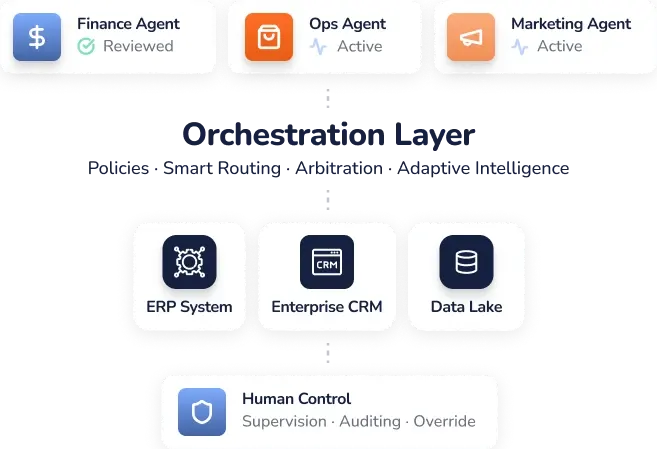
Pevaar develops the control plane for coordinating AI agents, business systems, and human decision-making within a single governance framework.
Kubernetes for Enterprise Decision-Making
A unified layer that coordinates, governs, and observes every AI-driven decision across your organization.
Goal & Intent Layer
Translates business objectives into machine-interpretable constraints and priorities.
Policy Engine
Enforces organizational rules, compliance requirements, and risk thresholds across all agents.
Decision Arbitration
Resolves conflicts between competing agent recommendations using priority hierarchies.
Human Control Plane
Surfaces decisions requiring human judgment. Escalation by exception, not by default.
Observability Layer
Full audit trail, decision lineage, and real-time monitoring of every AI action.
Built for executive outcomes, not technical bragging
Each capability is designed to answer the questions your board will ask — not the features your engineering team wants to showcase.
Goal & Intent Translation
Convert strategic objectives into executable constraints that guide AI behavior across the enterprise.
Agent Registry
Maintain a living catalog of every AI agent, its capabilities, permissions, and current operational scope.
Policy Constraints Engine
Define, version, and enforce organizational policies that every AI action must satisfy before execution.
Decision Routing
Route decisions to the right agent, human, or escalation path based on context, risk level, and domain.
Human Oversight Control Plane
Surface only the decisions that matter. Let humans govern by exception with full context and override capability.
Explainability & Auditability
Every decision documented with complete lineage: who requested, which agent decided, why, and what happened.
Enterprise Domain Application
Each component exists to solve a specific coordination challenge that enterprises face when scaling their AI initiatives.
Scenario
A manufacturing company runs 12 AI agents optimizing independent production lines.
Problem
Agents compete for the same resources, creating bottlenecks that go undetected by humans until it's too late.
Solution
The orchestration layer prioritizes by contribution margin, balances load across lines, and escalates to supervisors when resource conflicts are detected.
Implementation Method
Deliberate. Proven. Predictable.
We follow a structured engagement model designed for enterprise risk tolerance and organizational change management.
Assessment
Map your current AI landscape, identify coordination gaps, and evaluate organizational readiness for orchestrated autonomy.
- AI landscape mapping
- Coordination gap analysis
- Readiness evaluation
Architecture Blueprint
Design the orchestration layer: governance policies, agent registry, decision flows, escalation paths, and integration architecture.
- Governance policies
- Agent registry design
- Integration architecture
Pilot Domain
Deploy orchestration in a single business domain. Validate decision routing, policy enforcement, and human oversight workflows with real operations.
- Decision routing validation
- Policy enforcement
- Human oversight workflows
Enterprise Scale
Extend orchestration across departments. Refine policies, onboard additional agents, and mature governance practices as AI adoption grows.
- Cross-departmental expansion
- Continuous policy refinement
- Governance maturity
Why Enterprise Architects
AI orchestration is an architecture problem, not a tooling problem
Startups sell AI agents. Consultancies sell strategy decks. We design the operational architecture that makes autonomous enterprises actually work — reliably, governably, at scale.
Systems Thinking
We design for the enterprise as a whole — not individual departments. Every orchestration decision considers cross-functional impact.
Governance Design
Policies, escalation paths, and audit trails aren't afterthoughts. They're the foundation of every architecture we build.
Failure Modeling
We architect for what goes wrong. Circuit breakers, fallback paths, and graceful degradation are built into every layer.
Organizational Alignment
Technology alone doesn't create autonomous enterprises. We design for the human operating model that makes orchestration sustainable.
Pevaar doesn't sell development hours. We design the operating systems that allow companies to operate autonomously — with control, traceability, and strategic alignment.
Microsoft-first. Enterprise-proven
Built on the Azure ecosystem your organization already trusts. No exotic dependencies. No vendor fragmentation.
Enterprise Technology Stack
Built on world-class infrastructure to ensure security, scalability, and seamless integration with your existing business ecosystem.

Azure Cloud Platform

Power Platform & Logic Apps
Event-Driven Architecture
Security & Identity Governance
Observability & Telemetry
Addressing executive concerns directly
We address the core concerns of business leaders regarding the adoption of autonomous AI within their organizations.
No. Orchestration sits above your existing AI tools — including Copilot, custom agents, and third-party solutions. It coordinates their decisions and ensures they work together coherently within your enterprise policies. Your investments in AI tools remain fully intact.
By governing through policy constraints, not manual approval. We define the boundaries within which AI agents operate freely. Human oversight is invoked by exception — only when a decision exceeds defined risk thresholds, encounters novel scenarios, or approaches compliance boundaries.
They become first-class citizens in the orchestration layer. Existing automations are registered as agents with defined capabilities and constraints. The orchestration layer coordinates them alongside newer AI agents — no rip-and-replace required.
Pilot domains typically demonstrate measurable value within 8–12 weeks: reduced decision conflicts, improved compliance posture, and operational cost visibility. Enterprise-wide ROI compounds as more domains are orchestrated and cross-functional coordination improves.
Orchestration elevates human roles from routine decision-making to strategic oversight. Your people focus on judgment, governance, and exception handling — the work that actually requires human intelligence. The goal is augmented authority, not displacement.